VSEPR chart
Every molecular shape for two to six electron domains. Find the row for the number of domains on the central atom, then the column for how many of them are lone pairs.
VSEPR table: electron geometry, molecular geometry and bond angles
| AXE | Electron geometry | Shape | Angle | Hybrid. | Examples |
|---|---|---|---|---|---|
| AX2 | linear | linear | 180° | sp | CO2, HCN, C2H2, CS2 |
| AX3 | trigonal planar | trigonal planar | 120° | sp2 | NO3−, CO32−, SO3, BF3 |
| AX2E1 | trigonal planar | bent | <120° | sp2 | SO2, O3, NO2− |
| AX4 | tetrahedral | tetrahedral | 109.5° | sp3 | CH4, SO42−, NH4+, PO43− |
| AX3E1 | tetrahedral | trigonal pyramidal | <109.5° | sp3 | NH3, NF3, ClO3−, SO32− |
| AX2E2 | tetrahedral | bent | <109.5° | sp3 | H2O, H2S, OF2, H2O2 |
| AX5 | trigonal bipyramidal | trigonal bipyramidal | 90° and 120° | sp3d | PCl5, PF5, AsF5 |
| AX4E1 | trigonal bipyramidal | seesaw | <90° and <120° | sp3d | SF4, SeF4 |
| AX3E2 | trigonal bipyramidal | T-shaped | <90° | sp3d | ClF3, BrF3 |
| AX2E3 | trigonal bipyramidal | linear | 180° | sp3d | XeF2, I3−, ICl2− |
| AX6 | octahedral | octahedral | 90° | sp3d2 | SF6, SeF6 |
| AX5E1 | octahedral | square pyramidal | <90° | sp3d2 | BrF5, IF5, ClF5 |
| AX4E2 | octahedral | square planar | 90° | sp3d2 | XeF4, ICl4− |
How to read a shape off the chart
Draw the Lewis structure
The chart needs two numbers from it, both about the central atom. The Lewis structure generator gives you both for any formula.
Count the electron domains
Every atom bonded to the centre is one domain, whether the bond is single, double or triple. Every lone pair on the centre is one more. That total is the steric number, and it picks the row.
Count the lone pairs
How many of those domains are lone pairs picks the column. The electron geometry does not change along a row - only which positions have atoms in them.
Read the shape
The shape is where the atoms are, ignoring the lone pairs. That is why water, with four domains, is bent rather than tetrahedral.
Where the lone pairs go
With four domains every position is equivalent, so it does not matter which ones the lone pairs take. With five it does. A trigonal bipyramid has three equatorial positions at 120° to each other and two axial ones at 90° to three neighbours, and lone pairs take the equatorial positions first, where they are crowded least. That single rule gives the seesaw (SF4), the T-shape (ClF3) and the straight line of XeF2. With six domains, two lone pairs sit opposite each other, which is why XeF4 is flat.
Printable VSEPR chart
The same chart as an image, for a worksheet or a slide. Free to use in class.
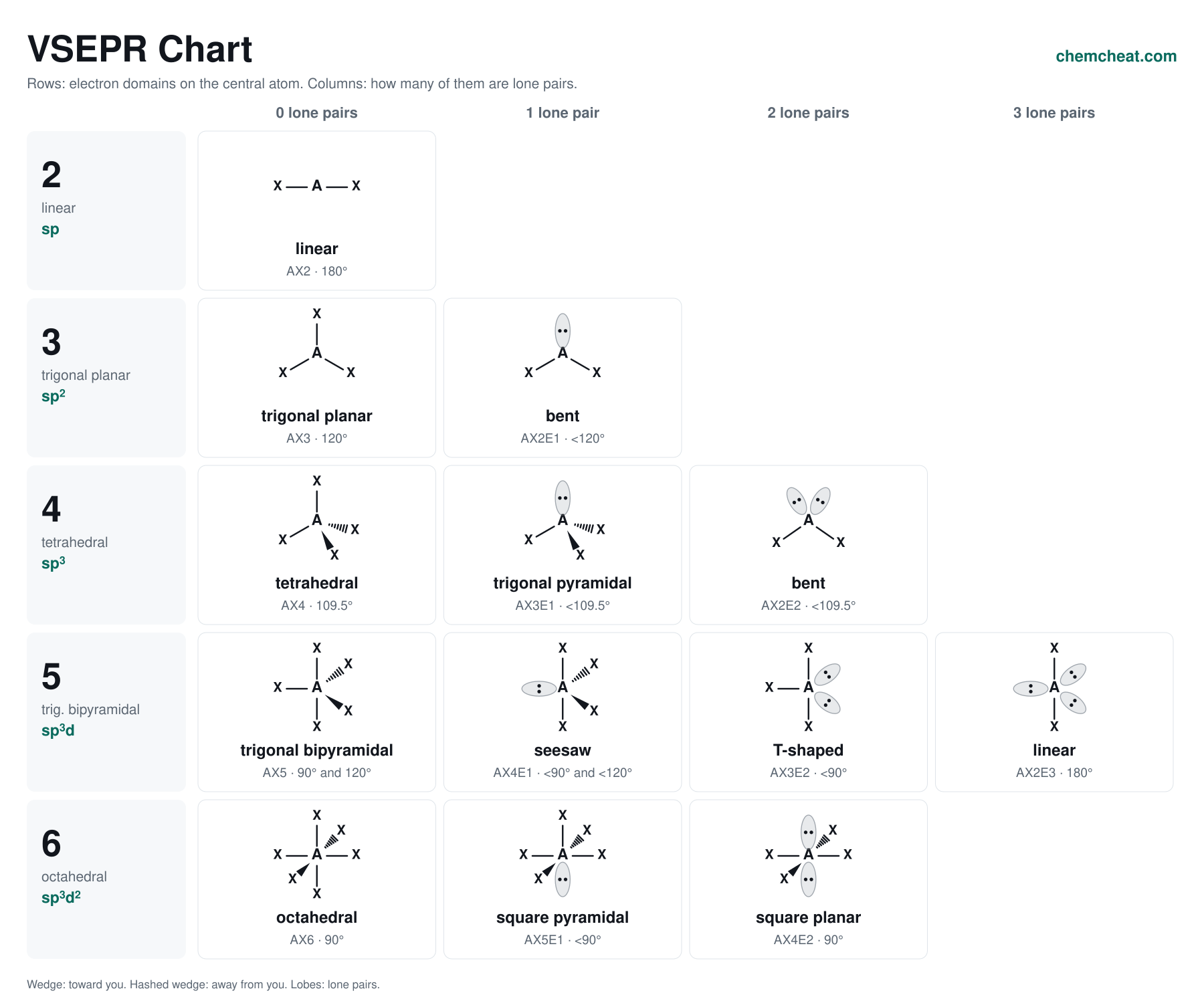
Download the PNG (1800 × 1500) →
Common questions
What is a VSEPR chart?
A table of the shapes molecules take, organised by how many electron domains surround the central atom and how many of those are lone pairs. VSEPR - valence shell electron pair repulsion - says those domains spread out as far as they can, and the chart lists where that leaves the atoms.
How do you use a VSEPR chart?
Draw the Lewis structure first. Count the electron domains on the central atom - each bonded atom counts once, whether the bond is single, double or triple, and each lone pair counts once. Find that row. Then count how many of the domains are lone pairs and read across to that column. The cell gives the molecular shape and the bond angle.
What is the difference between electron geometry and molecular geometry?
Electron geometry is the arrangement of every electron domain, lone pairs included. Molecular geometry is where the atoms end up - the shape you would see, since lone pairs are invisible. Water has tetrahedral electron geometry, because it has four domains, but a bent molecular geometry, because two of those domains are lone pairs.
What does AX2E2 mean?
It is the shorthand for a central atom A with two bonded atoms X and two lone pairs E. The numbers give the steric number directly: 2 + 2 = 4 domains, so the electron geometry is tetrahedral and the molecular shape is bent. Water is AX2E2.
Why do lone pairs make bond angles smaller?
A lone pair is held by one nucleus instead of two, so it spreads out closer to the central atom and pushes harder on the bonds around it. Each lone pair squeezes the angle further: methane is 109.5 degrees, ammonia with one lone pair about 107, water with two about 104.5.